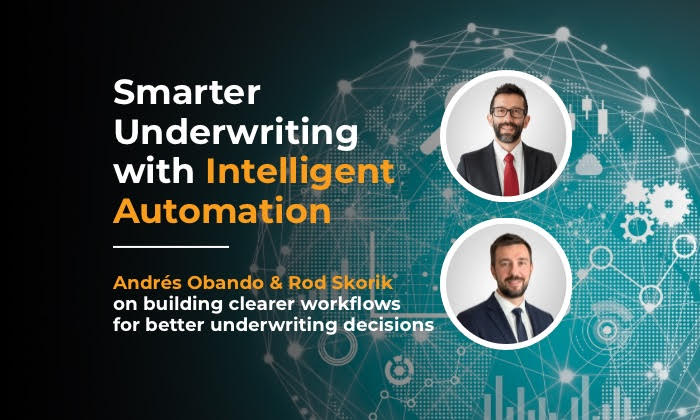
Smarter Underwriting with Intelligent Automation
Inside OutSmarter Underwriting with Intelligent Automation
How Mandarin Re is building clearer workflows for better underwriting decisions
In this Inside Out issue, Rod Skorik and Andrés Obando share a practical story from inside Mandarin Re: how automation, underwriting expertise and structured data came together to create clearer workflows, better portfolio visibility and more informed decisions. They discuss the challenges the team faced, the steps taken to streamline processes and the lessons learned along the way. Their experience highlights how combining technology with deep industry knowledge can help organizations improve efficiency, strengthen decision-making and build a more transparent foundation for future growth.
In reinsurance, technology creates real value only when it improves the quality of decisions.
That was the starting point for our work together at Mandarin Re. We were not trying to build a system for the sake of building a system. We were trying to solve a practical operational challenge: an underwriting team that was active and busy, but not always focused on the opportunities with the highest potential value, and a management view that did not always reflect what was happening inside the pipeline in real time.
From the outside, the operation looked functional. Submissions were being reviewed. Cases were moving. Business was being written. But the questions underneath were more difficult: which submissions deserved the most attention, where was underwriting capacity being absorbed, and how clearly could we see what was working across the portfolio?
That is where two different roles had to come together.
Rod’s perspective was automation, AI enablement and underwriting workflow design: how risk data, appetite criteria and submission logic could be structured before reaching the underwriter. Andrés’s perspective was underwriting reality: appetite, broker relationships, portfolio quality, conversion, and the daily judgment required to decide which risks deserve deeper engagement.
These two disciplines do not always speak the same language. But in our case, the gap between them became the place where the most useful work happened.
The problem we were solving
The underwriting team was not doing anything wrong. The issue was visibility.
Underwriters were reviewing submissions and making decisions, but underwriting time was distributed too evenly across the pipeline. High-value opportunities and lower-return activity often moved through the same process and required the same limited attention. Reporting existed, but it was manual, inconsistent, and often slightly behind the business.
From an underwriting perspective, this can feel like normal operating pressure. From an automation and workflow design perspective, it looks like a data structure problem. The information exists, but it is not always organized in a way that supports better decisions quickly enough.
As Andrés explains:
“The issue was not underwriting judgment. The gap was in how consistently submission data, portfolio signals and decision criteria were structured before the team had to act on them.”
The goal was not to replace underwriting judgment. The goal was to create a clearer environment around it.
What we built
Over the first quarter of 2026, we built several connected components. Each one started from a different practical question.
The first was a KPI framework for the underwriting team. This was not designed as a dashboard with attractive but superficial metrics. The purpose was to create a consistent structure across the team, with clearer definitions for conversion, hit ratio, submission quality, SLA compliance and capacity allocation.
That framework went through seventeen iterations before it became useful enough for the team. That number matters because it shows the difference between designing something that looks right on paper and building something that actually reflects how underwriting decisions are made.
The second component was an AI-assisted submission workflow. Before a case reaches the underwriter, it now goes through a pre-analysis step. Key risk parameters are extracted, the submission is checked against internal appetite criteria, and a structured brief is prepared. The underwriter receives a clearer starting point: the core risk characteristics, the relevant parameters, and the areas that require closer attention.
A majority of the underwriting team is now working with this process as standard. The change is visible not only in speed, but in the quality of engagement with each submission.
As Andrés puts it:
“When the brief is already structured, the underwriter spends time on the risk, not on interpreting scattered information. That creates a different quality of decision.”
The third component was reporting. Weekly and monthly formats were standardized, with consistent data points and clearer context. The objective was not simply to report numbers, but to understand what changed, what drove the change, and how the portfolio compared to the previous period.
Management can now see the underwriting operation with much greater clarity, instead of waiting for a delayed or fragmented view.
As Rod explains:
“Every workflow we build should capture and store the maximum amount of relevant structured data from the start. If the data is structured early, reporting, triage and AI support become much more useful later.”
What the numbers showed
Once the data became more structured, some important patterns became easier to see.
A structured analysis of submission flow, broker quality and portfolio outcomes showed that a meaningful share of underwriting time had been absorbed by lower-return activity: submissions that were unlikely to convert or did not align strongly with our appetite.
By reallocating underwriting attention toward higher-probability sources, we improved both acceptance ratio and hit ratio. More importantly, the business being written became better aligned with portfolio strategy.
The broker analysis also confirmed something Andrés had seen anecdotally: submission quality often tracks more closely with broker relationship quality than with geography or class of business alone. The same market can produce very different results depending on the source, the cedant engagement and the quality of the relationship behind the submission.
That insight matters because it changes how capacity is directed. It allows the team to focus not only on where business is coming from, but on which sources are producing the right kind of business.
In one new regional market, applying this logic helped create a live book of business that did not exist at the start of the year. The process began with one broker, structured submission criteria, and clear feedback loops. It was not a dramatic launch. It was disciplined execution, supported by better visibility.
What collaboration actually looks like
Building a system that underwriters use requires more than technical capability. It requires trust, pushback and a willingness to adjust.
Rod’s role was to design tools and workflows that reduce friction rather than add complexity. An automated workflow can be technically correct and still fail if it slows down the underwriter or produces output the team does not trust.
Andrés’s role was to challenge anything that looked reasonable in a spreadsheet but did not reflect the reality of the underwriting room. That feedback is what moved the KPI framework through seventeen iterations rather than stopping at the first version that appeared acceptable.
This helped separate reporting noise from decision-useful signals and kept the project focused on better underwriting visibility.
It also helped ensure that automation supported underwriting rather than distracting from it. Both sides stayed focused on the same objective: better decisions, better visibility and more disciplined use of capacity.
Where this goes next
The work is still developing. The email triage workflow launched in May, reducing submission registration time from roughly 24 hours to a few hours in selected workflows. The next step is to extend the AI-assisted brief across a wider range of submission types and integrate loss history analysis as a standard input.
But the broader point is not about any single tool.
It is about the relationship between the people building the system and the people using it. Automation designed in isolation from underwriting tends to remain isolated from the real decision-making process. The version that gets used is the one built close enough to the operation to understand where friction really exists.
For Mandarin Re, the value of intelligent automation is not simply faster processing. It is clearer underwriting focus, better portfolio visibility and more informed capacity allocation.
We are two people with different backgrounds working on the same problem. That tension is not an obstacle. It is the point.
Because in reinsurance, technology only matters when it helps people make better decisions.
This is only the beginning of a broader shift toward smarter, data-first underwriting workflows. More is coming.
Rod Skorik is Head of Automation & Innovation at Mandarin Re. Andrés Obando is Head of Underwriting at Mandarin Re.