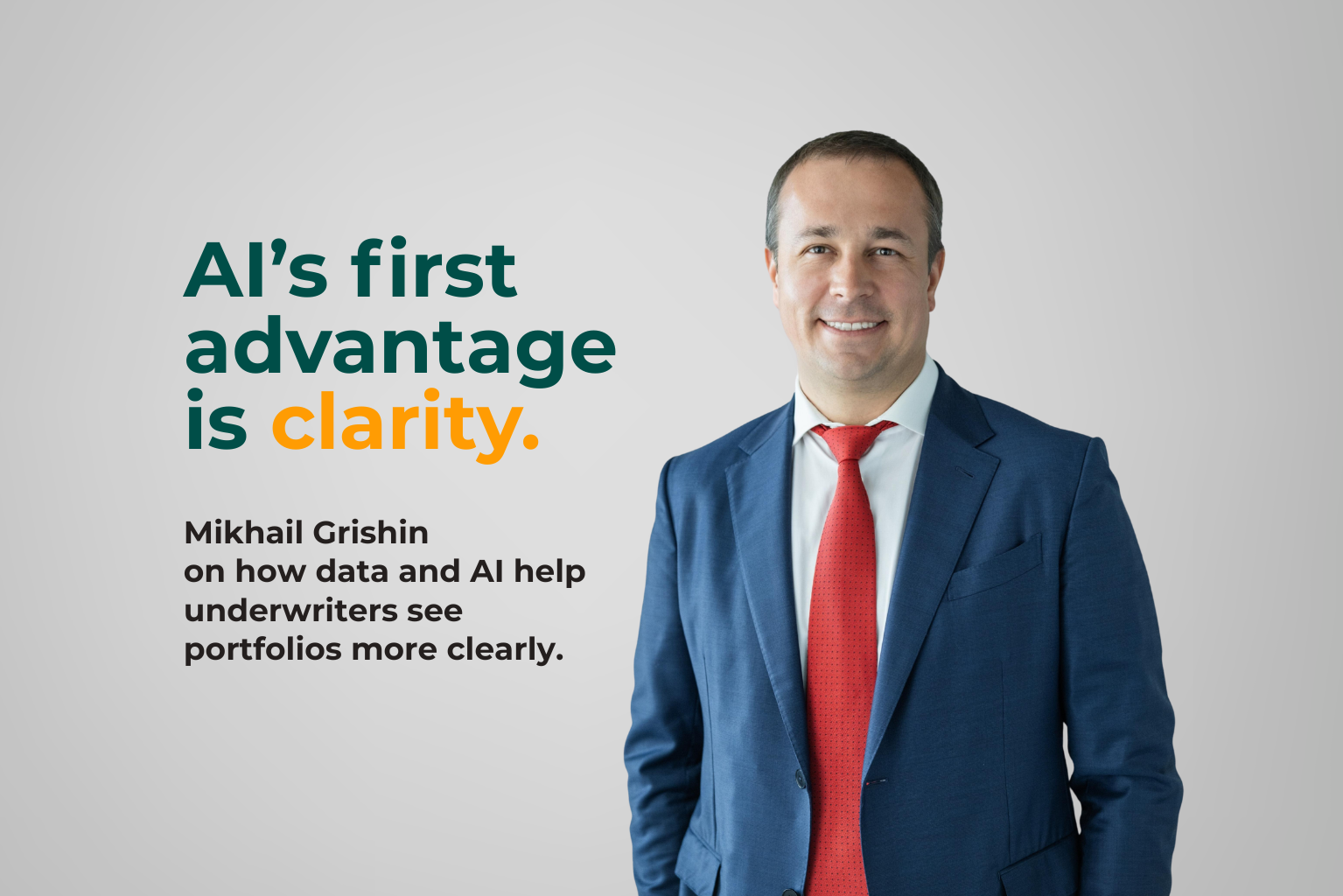
In reinsurance, AI’s first advantage is clarity
Inside OutInside Out: AI’s first advantage in reinsurance is clarity
Mikhail Grishin, Board Member / Chief Operating Officer, Mandarin Re
For years, reinsurance has discussed AI mainly as a future capability. But its most immediate value may be much simpler: helping underwriters see their portfolios more clearly.
Much of the conversation has focused on what AI may do in five or ten years: predictive modelling, automated treaty pricing, real-time catastrophe response. Important topics, no question. But there is a more immediate opportunity that receives far less attention, and it starts not with new technology, but with the data reinsurers already have.
Before AI can tell you something you did not know, it can often show you something you should have seen already. That distinction matters more than many firms realize.
Volume is not the same as value
In facultative reinsurance, submission volume can feel like a measure of market activity. The more that comes through, the more connected you are, and the more business you have the chance to write. There is truth in that. But there is also a problem that grows quietly alongside it.
Not every submission represents a genuine opportunity. Some of what arrives in the pipeline is well matched to appetite, priced appropriately, and comes from relationships with a real track record. A significant portion may not. The challenge is that both categories often land in the same queue and receive the same level of underwriting attention.
In a softening market environment, underwriting attention itself becomes a scarce resource. When competition increases and pricing pressure builds, the ability to understand where underwriting time should be focused becomes just as important as the ability to analyze the risk itself.
Over time, this creates a structural inefficiency that is difficult to see from inside the operation. Underwriters are busy. Response times may be reasonable. Cases are being reviewed. But a meaningful share of that activity can still consume capacity without producing results, while the cases that genuinely deserve deeper engagement receive the same limited time as everything else.
This is not a failure of effort. It is a visibility problem.
What the data showed us
At Mandarin Re, we ran a structured analysis of our submission flow using data from our underwriting management platform, combined with AI-assisted pattern recognition across the portfolio. The goal was straightforward: to understand where our underwriting capacity was actually going and whether that distribution made sense.
What we found was that the quality of incoming flow depends less on geography alone and more on which broker is generating it. Some partners were producing high submission volumes with limited returns. Others, typically those with direct local market relationships and genuine cedant engagement, were consistently delivering results above our portfolio average. Refocusing on the right sources within the same geographies produced a measurable shift.
Measured results
Acting on this analysis, we restructured how we allocate underwriting capacity across our broker network. The shift was not dramatic in terms of the total number of relationships. The difference was in focus and prioritization.
The outcome was tangible. By concentrating underwriting time on higher-probability opportunities, we freed approximately 23 percent of underwriter capacity that had previously been absorbed by lower-return activity. Alongside that, our acceptance ratio and hit ratio improved meaningfully. The business we are writing is more aligned with our appetite, and the conversion from submission to bound case is more efficient.
These are not projections. They are outcomes from applying data analysis to a question we had not asked clearly enough before: where should our underwriters actually be spending their time?
Raising the standard of the work itself
Capacity reallocation was one part of the picture. The other was internal, and in some ways more significant for the long term.
One of the clearest gains from combining AI with structured data has been in how submissions are handled before they reach the underwriter. Rather than arriving as a raw package requiring full interpretation from scratch, each case can now be pre-analysed against our internal underwriting criteria. The underwriter receives a structured brief: the key risk characteristics, the relevant parameters, and the areas that need closer attention. The analytical groundwork is done before the conversation even starts.
This changes the quality of the underwriting decision, not just the speed of it. When the underwriter engages with a case, they are engaging with the substance of the risk rather than working through the mechanics of information extraction.
Alongside this, we have been investing in standardising how underwriting is reported and tracked internally. Consistent formats, data points and benchmarks matter. When every case and every period is captured in a consistent way, it becomes possible to see the portfolio clearly and make informed adjustments. Without that foundation, data analysis can produce noise rather than insight.
The role of the underwriter does not diminish
None of this replaces the underwriter. Risk assessment, relationship judgment and the final decision on terms remain with the person who understands the context. What changes is the environment around that person.
AI and structured analysis can reduce the interpretation gap between what is happening in the portfolio and what leadership can see. They surface patterns that would otherwise take weeks of manual work to identify. They make it possible to ask specific operational questions and get answers quickly enough to act on them.
In a business where decisions compound over years, and where poor risk selection may only become fully visible long after the fact, that kind of clarity is a genuine competitive advantage. Not because it removes complexity, but because it makes complexity more manageable.
The practical question
The firms that benefit most from AI in underwriting will not necessarily be the ones with the most advanced models. They will be the ones building data discipline now, while the tools are still being adopted rather than assumed.
That means consistent data collection, structured analysis of what you already know, and the willingness to act on what the data shows you, even when it challenges assumptions held for a long time.
The future advantage in reinsurance may belong not to the firms with the most AI, but to those that achieve the clearest understanding of their own portfolios. We are still building, but the direction is clear, and the early results have confirmed that the work is worth doing.